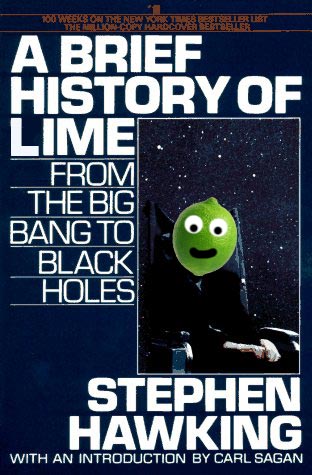
Meh

OK, so the blog-a-day experiment was a miserable failure. The good news is, it’s because I’ve been keeping busy in real life. Lots of fun, and some secret plans – which I’m sure I’ll be posting about soon. Anyway I went to a talk by Roger Penrose today, and am quite proud of the fact I survived three quarters of an hour before getting totally lost. His new theory is quite cool, if a little confusing, maybe I’ll find time to write about that (or what I understood it to be) It’s scary – I got there 20 minutes early and the lecture theatre was almost full. And this is a BIG lecture theatre, given that it seats all the Part IA Phys NatScis for Maths lectures. Apparently they had to turn away 200-300 people.

Also, Screenwipe is back. Huzzah!

Blog-o-fail

Ok, so there was no post yesterday. I blame being unexpectedly dragged into the lab, resulting in being out from 8.40 till half past midnight. Although the later bit may have been due to watching “classic” 80s music videos in the MCR. Hooray for Sky! I did make it home for about half an hour actually, but getting food somehow took priority.

Anyway, I finally took a look at the Wikimedia Foundation’s first Annual Report. It’s impressively professional, it really shows how far the Foundation has come. And I say this having been to a careers fair today, where I was bombarded with many nicely put together booklets. I think the WMF one is my favourite, and not just because it’s something I’m rather close to. The report is well worth a look if you want to find out more about Wikimedia – the “anatomy of a wikipedia article” in the middle is particularly wonderful.

No time for a title

Well, Brianna posted about “NaBloPoMo” – National Blog Posting Month. Even though I’ve missed 2 days, and have less than 10 minutes left to post this, I’m going to try and post every day for the rest of November. Should be a challenge, given my previous neglect of this blog. There’s a few things I have in mind to write about, and just never get round to it, so this should be an incentive. And I’m sure I can throw in some filler without enraging too many people.

Here’s some awesome music to start things off:

Random article: Faddeev-Popov ghost

Things like this make me wonder if quantum physics isn’t all a hugely elaborate practical joke by scientists on the rest of us mere mortals. Negative probabilities? Seriously?

In physics, Faddeev-Popov ghosts (also called ghost fields) are additional fields which need to be introduced in the realization of gauge theories as consistent quantum field theories.

The Faddeev-Popov ghosts are sometimes referred to as “good ghosts“. The “bad ghosts” represent another, more general meaning of the word “ghost” in theoretical physics: states of negative norm—or fields with the wrong sign of the kinetic term, such as Pauli-Villars ghosts—whose existence allows the probabilities to be negative.

Unclear

This is what appears at the top of Wikipedia’s Microsoft Reader article. If you don’t know, the logo is supposed to say “Microsoft Reader with ClearType”. Obviously this is a Wikipedia problem, and could be fixed by changing the image size, but for once I can’t be bothered because it’s too wonderfully ironic like this. Besides, Microsoft Reader is an evil product.

Mah first mashup!

Well I spent some time messing around in Ableton Live when I really should have been working, and now exams are over decided to finish something up and post it. So it’s pretty short, the ending really sucks, and it clearly only works at all through blind luck because all my attempts to produce anything else have failed miserably. But I’m quite proud of it all the same. Enjoy. (And please don’t sue me.)

techno-episode.mp3

Random article: Rosenhan experiment

The Rosenhan experiment was a famous experiment into the validity of psychiatric diagnosis conducted by David Rosenhan in 1972. It was published in the journal Science under the title “On being sane in insane places.”

Rosenhan’s study consisted of two parts. The first involved the use of healthy associates or “pseudopatients,” who briefly simulated auditory hallucinations in an attempt to gain admission to 12 different psychiatric hospitals in five different states in various locations in the United States. The second involved asking staff at a psychiatric hospital to detect non-existent “fake” patients. In the first case hospital staff failed to detect a single pseudopatient, in the second the staff falsely detected large numbers of genuine patients as impostors. The study is considered an important and influential criticism of psychiatric diagnosis.